
By Libby Riddle, UM News Service
MISSOULA – To become a wildland firefighter, you must pass the pack test. Often considered the most daunting requirement of wildland certification, the test requires fire trainees walk 3 miles in less than 45 minutes while carrying a 45-pound pack, simulating the physical demands of working on a fire line.
Knowing her trainees were nervous, Mikaela Balkind and her co-instructors showed up to the pack test wearing matching disco ball earrings. She applied glitter to the cheeks of anyone who needed some extra encouragement. She cheered them on as their sparkling faces charged through the trees and over the finish line.
The pack test took place on the final day of the Women in Wildfire Training held this fall at the 91视频’s Lubrecht Experimental Forest. Inspired by her own experience as a wildland firefighter, Balkind, a UM graduate student, created this training to empower young women to join the wildfire profession, where women make up less than 15% of the national workforce.
“When you look at the media about firefighters, women and BIPOC people don’t see representations of themselves,” Balkind said. “So it feels really scary to break into a field where no one that looks like you is saying ‘you got this.’ We’re trying to break down those barriers.”
After getting her bachelor’s degree in forestry and climate science, Balkind spent several seasons as a firefighter. She enjoyed the hard work and the connection to the outdoors, but she felt isolated when she was the only woman on her crew.
“With a few years under my belt, I recognized how important it was to find female mentors,” Balkind said. “The seasons that I didn’t have that were really difficult for my mental health.”

When Balkind arrived at UM for her master’s work studying fire ecology, she noticed the forestry and fire clubs that prepare students for wildfire careers were still very male dominated. She spoke with female students who expressed that despite the college’s opportunities to participate in wildfire activities, they still felt intimidated. She worked with Valentijn Hoff, the interim director of UM’s Fire Center, to secure funding for a wildfire training specifically for young women. In this second year putting on the training, she had over 50 applicants from all over the country.
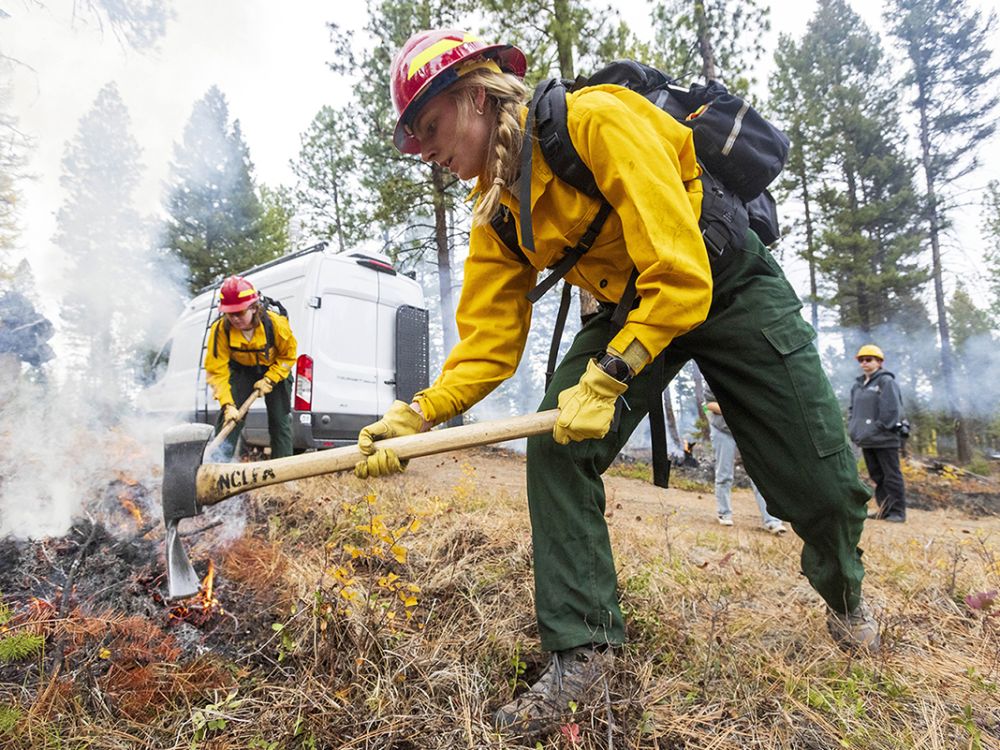
One of Balkind’s main goals for the four-day training was to create pathways for women to apply for wildland fire jobs. Participants completed all the necessary requirements for the “red card” certification, which qualifies them to work as a wildland firefighter in the U.S. This involved 32 hours of classroom learning plus a field experience and the pack test. The trainees also participated in a prescribed burn, where they learned to use drip torches and properly operate a fire engine.
The participants spent much of their classroom time learning from female fire professionals. Balkind wanted to introduce participants to the variety of possible careers in fire, so she invited women who worked on hotshot crews, women who study fire ecology and even a mental health professional employed by the U.S. Forest Service’s emergency mental health response team who works closely with firefighters.
“It was honestly inspirational hearing where they started and what obstacles they faced getting to where they are now,” said Jessica Olaez, who traveled all the way from Lakeland, Florida, for the training. “You could really see how much they love what they do. Seeing the passion in their eyes when they talked about it was so encouraging.”
UM freshman Tegan Holme dreamed of being a firefighter since she was a child. When she learned about the training from the W.A. Franke College of Forestry and Conservation’s forestry club, she jumped at the opportunity to finally try wildland firefighting for herself. Thanks to the field experience and speaking with the lecturers, Tegan realized working in wildfire was much more attainable than she thought. She plans to apply for a wildfire job with a state agency this summer.

“What really stuck with me is that no, it won’t be the same for us as it is for a grown man standing at 6’5” and 210 lbs.,” Holme said. “But we can find our own ways to do the same job just as safely, efficiently and easily for us and our bodies as a man can by doing it the ‘standard’ way.”
Other participants found more inspiration in the science side of fire. Balkind intentionally incorporated lectures on fire ecology to give participants a more holistic understanding of wildfire.
“We learned about what makes ponderosa pines unique and how that informs different burning strategies,” said UM wildlife biology major Chase Sabbagh. “I’d rather do research on fire science than dig fire lines, but I have a ton more respect for the people that do that after this training.”
“I learned that I don’t think I want to work in wildland fire, but I’m glad I was able to try it out,” added Gabi Neely, a UM environmental science and sustainability major. “I’m really grateful to Mikaela and the Fire Center for offering this.”
Though they don’t see themselves pursuing careers as wildland firefighters, Sabbagh and Neely said they will apply what they learned at the training to other parts of their lives.
“I learned strategies to advocate for myself and find my own ways to do things instead of trying to fit into the methods made for someone else,” Sabbagh said.
UM’s Women in Wildfire training created career opportunities not only for UM students, but also women from states around the country where similar programs have been defunded. Balkind expressed her gratitude to the many professionals who volunteered their time to plan and put on the training.
“The instructors and volunteers aren’t getting paid. They’re there because they believe in this mentorship program and in building confidence in these younger gals,” Balkind said. “And I’m so grateful that Missoula is such a hub for all these incredible women that support this.”
Balkind will graduate this fall with her master’s degree in forestry. She hopes a new student will step into her shoes to run the training next year and that she can return as an instructor.
“I leave feeling so inspired by the next generation of ladies coming into this field,” Balkind said. “I’m excited that I might run into them at a fire ecology conference or on a fire line in the future.”

###
Contact: Dave Kuntz, UM director of strategic communications, 406-243-5659, dave.kuntz@umontana.edu; Libby Riddle, science communications coordinator, W.A. Franke College of Forestry and Conservation, elizabeth.riddle@umontana.edu.