By Kyle Spurr, UM News Service

MISSOULA – Da’Myah Buckner never expected her academic career would take her to the 91视频, where she is pursuing a Ph.D. in speech, language and hearing sciences.
Buckner grew up in Chester, Pennsylvania in the Philadelphia metropolitan area and earned an undergraduate degree in linguistics and then a master’s degree in linguistics.
When looking where to apply for a Ph.D., Buckner connected with a professor from UM’s speech pathology department and was sold on the doctoral program in Montana. She started the program this past January and said she has felt supported from the faculty while researching bilingual children with language disorders.
“Being so far from home, it feels really good that everybody has been so nice and welcoming,” Buckner said.
UM’s speech language pathology Ph.D. program launched in 2016 and has worked closely with the Graduate School and Office of Research and Creative Scholarship to increase the number of Ph.D. students that are enrolled and funded. The program started small with one or two students at a time. It has grown to a cohort of three students, and four more have applied to start next fall. The program is expected to keep increasing in coming years.
Laurie Slovarp, an associate professor in the School of Speech, Language, Hearing and Occupational Sciences and director of the Ph.D. program, said doctoral students are drawn to the program to advance research that directly supports clinicians and patients.
“The main thing is to be able to move the field forward,” Slovarp said. “If you are a clinician, you are relying on research. We have these researchers who make our field better and that leads to advances in clinical care.”
Students like Buckner enjoy the smaller, supportive atmosphere in the program, where they have access to mentorship as they pursue their research. The students also are given more opportunities to teach at the graduate level compared to programs at other universities, Slovarp said.
“Just being in a smaller program really lends itself to a lot of personalized mentorship,” Slovarp said. “Everyone works well together and all of our Ph.D. students are brought into the fold when it comes to research.”

The two other Ph.D. students in the current cohort Kassidi Heinle and Sarah Conkle agree the program gives them the support they need to explore their research topics.
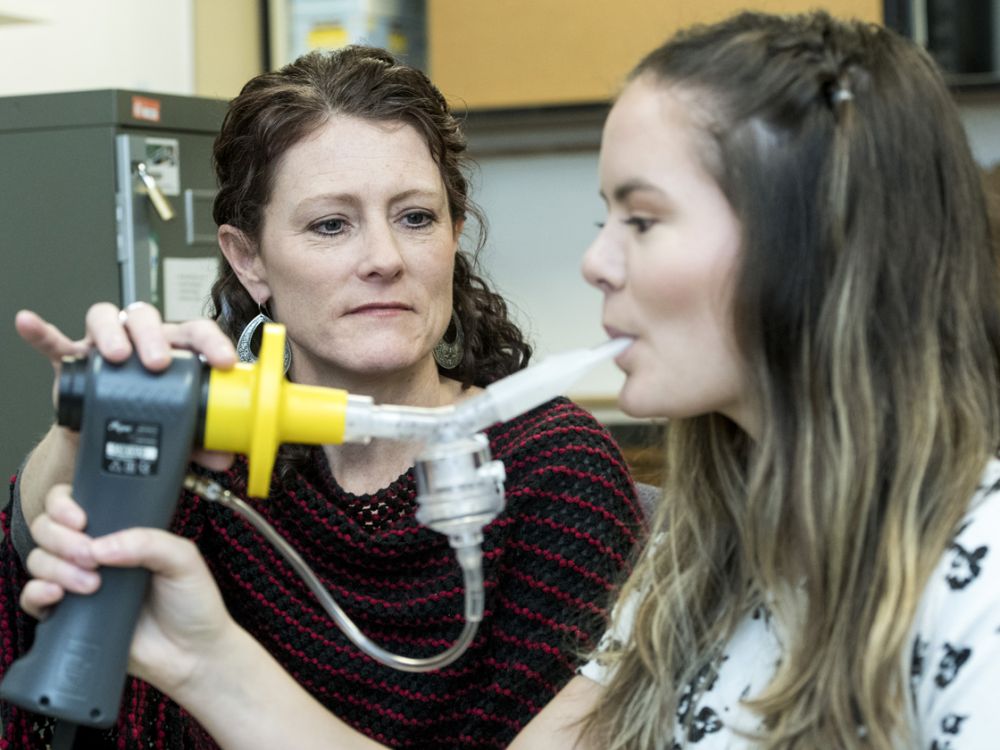
Heinle, from Miles City, started as an elementary education major at UM and taught for five years before returning to UM to earn a master’s degree in speech language pathology. She now works as a speech language pathologist in Missoula and started the Ph.D. program this past year. Slovarp is mentoring her as they work together to research a chronic cough suppression treatment.
“For me, it just made sense,” Heinle said. “I knew who my mentor would be. I already knew we work well together.”
Heinle said the program was a good fit for her because she can continue to teach while working to expand research into a topic she is passionate about.
“I was a teacher before and I want to keep teaching,” she said. “I get to teach now at a different level, and I get to continue to be a clinician and be a part of this research.”
Conkle also has a teaching background between the time she earned a master’s in linguistics at UM in the 1990s and returning in 2020 to study speech language pathology. At one point, she lived in Japan to teach English as a second language at a university near Tokyo.
Conkle completed her master’s degree in speech language pathology and worked as a clinician before returning again to start her Ph.D. with a focus on aphasia research. Aphasia is an acquired language disorder, most commonly caused by stroke, that impairs a person's ability to understand and produce spoken language, read and write.
She studies aphasia with her mentor Dr. Catherine Off, chair of the School of Speech, Language, Hearing and Occupational Sciences.

“I wanted to go back to complete this Ph.D. program and do research so I could add to that body of knowledge and that field,” Conkle said.
Conkle, who grew up in Wisconsin, always had an interest in aphasia and how people’s language can be impacted after having a stroke. That interest became more personal when her father had aphasia after a stroke a few years ago.
“That made it even more personal and made my commitment even stronger,” she said.
Conkle would encourage any student interested in pursuing a Ph.D. in speech language pathology to strongly consider UM, where she said the faculty and students are completely committed to their studies and pushing research forward.
“It’s a special group of people here,” she said. “I don’t think you could find a better place to get a Ph.D.”
###
Contact: Dave Kuntz, UM director of strategic communications, 406-243-5659, dave.kuntz@umontana.edu